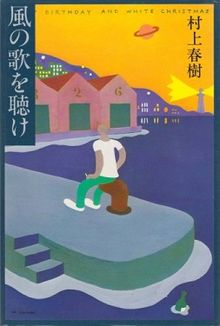
Published: 1979 (Kodansha)
Setting: Niigata, Japan.
Summary: Its 1970, and an unnamed narrator, “I”, goes home to Niigata for summer vacation, hangs with his buddy, “Rat”, and his bartender, J. J is a cool customer, and his bar is where most of the action takes place. “I” starts his vacation by waking up next to a girl who passed out at the bar. “I” doesn’t know her, and she promptly kicks him out. He didn’t do anything but take care of her, but let’s just say it was an awkward first encounter. She has nine fingers to her name, and “I” has seemingly no chance at making her think any differently of him. “I” and Rat drink copiously at the bar, and Rat takes up reading, an activity he was previously indifferent about. Throughout the book, “I” cycles through recollections of his favorite author, (the fictional author) Derek Hartfield, the DJ of the local radio station, his first three uncles, and the three girls he had previously slept with.
“I” develops a relationship with the girl with nine fingers, who works at a record shop. An integral aspect of Murakami’s writing style is showcased here, as he mentions the Beach Boys, Bob Dylan, and Beethoven, a nod to western popular culture. Another motif which reoccurs in Murakami’s work and makes its debut in this first novel is the use of wells. His first descriptions of a well points to their vastness, the human ability to construct them perfectly, and the mysterious presence and lack of use of wells in Hartfield’s novels. Look for these aspects throughout Murakami’s work. Going back to the record shop, “I” runs into the girl with nine fingers, and ends up being invited to a dinner, and eventually a date. The girl leaves to get an abortion, comes back and has one final date with “I”, before jetting off, never to be seen by “I” again. “I” ends his story by noting that he is married in Tokyo, and Rat is writing novels, which he sends to “I”, presumably to edit.
This novel is short and sweet. It provides a brief window into the core of “I”, a character whose story we pick up again in Murakami’s second novel, Pinball, 1973. A Wild Sheep Chase, and Dance, Dance, Dance round out this tetralogy.
Quote of the book: “At the same time, though, I love writing. Ascribing meaning to life is a piece of cake compared to actually living it.” -“I”
Favorite character: Rat, this man reads, he writes, he drinks, and his imagination and temperament are raw and real. He works as an exciting counter to “I”’s coolness.
Favorite setting: The harbor where “I” and the girl had their last date.
Favorite pop culture reference: Murakami using the lyrics to the Beach Boys, California Girls (1965)
Please Stay for: The origins of Murakami, his first mention of wells, his hand drawn t-shirt “I” won in a radio contest, and his descriptions of cooking and eating food.
Please Excuse: The sparse detail and context surrounding Rat and “I”.
 Will Reviews Things