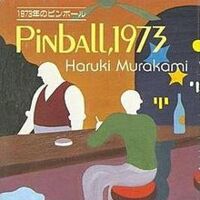
Published: 1980 (Kodansha)
Setting: Niigata, Tokyo
Summary: In the second book of a tetralogy, and second in the “Trilogy of the Rat”, our unnamed narrator, “I”, is obsessed with pinball. This time, instead of a girl with nine fingers, he is seeing identical twins. Sweatshirt-clad and always willing to cheer “I” up, these ladies hold a funeral for a circuit-breaker and collect golf balls at the country club for fun. This book moves from “I”’s forays into the translation business, his recollections of his former love Naoko, his obsession with pinball, to the tragic loneliness of “Rat”, “I’s” best friend who has a deep but ultimately futile tryst with a mature and principled woman. Every Saturday, Rat goes and takes her out, connects with her, and the rest of the week he spends fawning over her and stressing about their next encounter.
In this novel, Rat is more introspective and forlorn, looking inside and finding that his childhood insecurities and boredom have not been resolved. He eventually leaves J’s bar after one final beer, off to backpack around Japan. Rat may have reached enlightenment, or some form of catharsis in this novel, but it is unclear where he is going, or what he will find.
“I” seems to be able to process his childhood associations with Naoko, wells, and the way these childhood memories, located deep down in a well, are manifesting in his adult life. He doesn’t have any answers, but like Rat, he is growing up and looking back far more than in Hear the Wind Sing (1979, see review). This leads him to pinball. He harkens back to a connection he has to Rat, who he shared a summer of pinball with. “I” lives in fits in starts, he is mute as a child, then won’t be quiet. He scours Tokyo for one pinball machine, locates it, and then lets it go completely. “I” is playing a constant game of catch and release in this novel, he seems to have enough energy to keep something long enough to enjoy it without letting it define him or give him a purpose once he has attained it. He is purposeful in acquisition, and purposeless in relationships. Rat is the opposite, he barely remembers how he starts sleeping with his girlfriend, but cries when he loses her and leaves J.
Overall, this is a huge step-up for Murakami in his second novel. He breaks out onto the national literary scene in 1982 with a Wild Sheep Chase, but in this work he lays the groundwork for a deeper dive into the story of “I”, Rat, and their relationship.
Quote of the book: “In the autumn of 1973, we could sense something nasty lurking just out of sight. The Rat felt it like a pebble in his shoe” –“I”
Favorite character: 207, and 208 (the Twins). These ladies are upbeat, helpful, and sexy without being desperate or truly reliant on “I”. They move to the beat of their own drum, fill a space for “I” in a time where he is still a bit lost, and leave when they feel like it. If only I had someone, or something move into my life, bring me joy, and slip out without any hang-ups.
Favorite setting: “I”’s Apartment, we get an intimate and detailed description of his apartment in Tokyo, mainly through descriptions of the Twins and their unique behavior (cleaning the kitchen naked, knowing the exact location of the circuit breaker).
Favorite pop culture reference: The Knights of the Round Table, there is no glorious moment in life that acts as a capstone for “I”, he moves through life and doesn’t cling too tightly to anything.
Please Stay for: The relationship between “I” and the Twins, the use of wells as a motif for the mind.
Please Question: The lack of interaction between Rat and “I”.
 Will Reviews Things