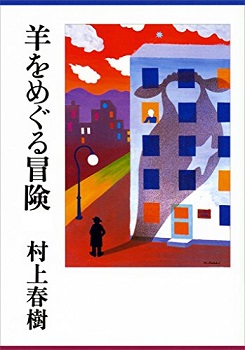
Published: 1982 (Kodansha)
Setting: Tokyo, Hokkaido, Niigata
Summary: In the third book of the “Trilogy of the Rat”, Murakami decides to blow it all up, in a good way. Our unnamed protagonist, I, meets a beautiful part-time call girl with magic ears, the secretary of the underground Boss of Japan, as well as the Sheep Professor and his holy grail, the Sheep Man. This novel takes us back to Niigata, where we meet J and the woman the Rat had a relationship with in Pinball, 1973. Murakami made the decision to bring the Rat’s story to end, having him kill himself to save the rest of Japan and the world from the illusive and parasitic sheep, which latches onto its host until their usefulness has dissipated. After a quick trip to Niigata this novel takes us to the snowy climbs of Hokkaido, where I faces his past and drops everything he has known, including his wonderful partner and her magical ears, to forge a new path.
In chapter 6, I’s girlfriend tells him that, “You don’t understand anything.” This proves to be prophetic as every turn in the plot of the novel is punctuated by I’s confusion and propulsion forward by forces outside of himself. Firstly, I is asked by the secretary of the Boss of Japan, with his shady past in Manchuria, to find a sheep with a star on its back after I puts it on an insurance advertisement. Then, before he sets off to go to Hokkaido, he has to say goodbye to the Rat’s girlfriend for him while he settles in Hokkaido. I follows the Rat’s instructions, has an awkward dinner with his ex-girlfriend, and then returns to get his buttons pushed by the secretary again. We do get a good conversation with J, who we say goodbye to at the end, with a check in his pocket passed from the secretary to the narrator and finally to J. The Boss’s secretary puts I in an impossible situation he does not understand, he has to find the sheep in two months’ time with no information of its whereabouts. Again, at every turn the narrator is getting pushed and pulled into situations he has no knowledge or real stake in, others plant their flags into I’s life.
We pick up the story of I’s translation business from Pinball 1973. His partner gives him the news of the Boss who wants our narrator to find this sheep. Before I goes to Hokkaido, he has to quit the business he grew from the ground up. Throughout the novel the narrator drops all of the weight from his life like a stud sheep after a hundred sessions in the female pen. He loses his friend, his translation business, his best friend, and is left with the core of who he is and free beer from J the next time he visits.
The story of the sheep is a straightforward detective setup, where I and his girlfriend go to the Dolphin Hotel and stumble into all of the clues and facts they need to get to Hokkaido. Once they get to the pasture and house, where all of the people who the sheep inhabited lived at one time, the girlfriend leaves and I figures it out that to finish the mission he must face his friend, the Rat. The Rat turns out to be the final connection the sheep and humans have; The Rat has to hang himself with the sheep inside it to stop the sheep from latching on to its next host.
The final part of this novel is deepest and most effective portion of the novel. On my third read of this story, I found the first 3/4ths of this novel as one long setup for the final payoff of one conversation. The Rat and I bare all, and the connection between the Boss, the Sheep Professor, and the Rat is found. This house is the vector, the lifeforce of the sheep. Everyone who enters this Hokkaido sheep house is attached to a supernatural force, and only the naïve and unconnected narrator can remove the sheep’s power.
Overall, this novel connects disparate strands of the first two novels and connects them to the Rat. The Rat isn’t as active in this novel as the first two until the last 30 pages or so, but this was a fitting end to his story. The narrator has one more story, Dance Dance Dance, but the Rat’s vagabond existence is over. This story comes to a satisfying end, and ultimately serves as Murakami’s first full-length novel. Although this novel is fun and has a nice mystery twist, the narrator’s path seems far less important than the Rat’s. If there was more of the Rat, and more of a conflict with the Rat and the narrator, I would have enjoyed this novel more. However, it establishes Murakami’s trademark style and propelled is career forward, a career filled with some of my favorite literary works.
Quote of the book: “Body cells replace themselves every month. Even at this very moment. Most everything you think you know about me is nothing more than memories.” -I’s ex-wife
Favorite character: I, the narrator shines in this novel. Even though he seems to be lost and adrift, he takes action on the behalf of almost every character he encounters, helps J pay off his loans for the bar, and accepts that he lost his girlfriend while trudging ahead. He reconnects with the Rat while accepting his death and taking on the role of the facilitator of destruction to the parasitic sheep. He even makes friends with the old Sheep Professor, the chauffeur, and other odd balls who others might dismiss.
Favorite setting: Hokkaido, the description of Hokkaido makes you want to travel to it right now. Maybe not in the winter, but definitely in the early fall. The crisp air and the mountain climbs, the run-down towns and the mountain homes make it seem like the perfect getaway for a quiet vacation.
Favorite pop culture reference: Nat King Cole’s South of the Border, all I have to say is FORESHADOWING!
Please Stay for: The narrator shines in this novel, especially compared to the first two books.
Please Question: The lack of the Rat in the meaty portion of this third installment.
 Will Reviews Things