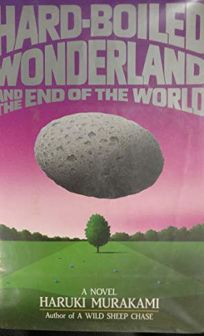
Published: 1985 (Shinchosha)
Setting: Tokyo, “The Town”
Summary: In Murakami’s favorite novel, our main characters shuffles information as he shuffles around the Tokyo underground. In alternating chapters, Murakami builds a Tokyo city-scape full of data inquirers professors, and Inklings (based on kappa), while also building an imaginary town within the mind of our main character.
Our main character, an unnamed middle-aged man, has been programmed to process data in the “Black box” of his mind. The novel begins in an office building, where the man has been commissioned to shuffle data for a professor, the architect of the shuffling system. The man works for the Calcutecs and has skills that nobody else in this world has. He is whisked to the subterranean offices of The Professor by his cheeky, and chubby, granddaughter. The Granddaughter has an allure to the man, partially because she only wears pink and seems to have a peculiar set of skills. She helps the man navigate an underground passage full of murderous Inklings, using sound waves and light as a deterrent. Once he gets to the office, he performs the data shuffling, and learns that the Professor is working outside the strictures of ‘Big Information’ to create an application which removes sound. Once the man comes home, he goes to the library to learn about a unicorn skull the professor gave to him. He meets a cute and ravenous librarian who he treats to a bountiful meal in exchange for books on unicorns. After she leaves, he is thrown around by a couple of thugs who wish to shake the man down for the information. They know he is a target of the rival Semiotics and want to deliver him up for a price. After roughing the man up, the thugs leave. The granddaughter comes back into the picture and warns the man that the end of the world is near. Little does the man know, “the end of the world” is his code name that was etched into him as a subject, and into his mind as his subconscious. The man and the granddaughter must go back to the lab through a dangerous maze to reach the professor, who tells the man that he will die in thirty-six hours. The man spends his last thirty-six hours driving in a rental car listening to Dylan, sleeping with his librarian friend, and waiting for his laundry to dry. The granddaughter takes over his apartment as he waits for the end of the world in his mind.
This is not the end of the man’s story, however. The novel alternates chapters, and in the second chapters of this back and forth sequence the reader is introduced to “The Town”. The town is surrounded by walls, has characters like the Gatekeeper, The Colonel, and the Librarian who have no minds but are peaceful. Our character learns the secrets of the town after his shadow is removed from his body and imprisoned. The man becomes a Dreamreader, where he reads the displaced minds of those in the town, whose minds are absorbed and die with “The Beasts”, who are unicorns. The man, who is now the Dreamreader, reads the skulls with assistance from the Librarian. The Dreamreader gets close to the librarian, maps the town after a request from his shadow, and ventures into The Woods where he learns the secrets of the town. In The Woods he finds old and underused instruments which make music, filling the emotional hole our character sunk into when he entered The Town. Once he finds that he can read the mind of the Librarian, he hatches a plan to help the shadow escape their imprisonment so that they can go on while the Dreamreader learns more about The Town. His goal is to destroy The Town from the inside so that he does not live in eternity. We don’t get closure as to what his life will be like after his shadow leaves him and goes back into The Town, but we leave the Dreamreader with him having a purpose and a love.
This novel connects issues of large capitalist data systems with the subconscious and the mind. Murakami connects the essential elements of Hard-boiled and action-packed detective stories with a tinge of cyberpunk, while focusing on more intellectual themes of the processes and parts of our mind that we still do not understand. The novel’s structure of alternating chapters moves you through the surreal and quaint story of The Town, only to snap you back into the distorted reality of Inklings and information wars in Tokyo. The main character is well-developed, partially because we follow his story on two tracts. I could have read a much longer and more exhaustive novel with these settings and characters and be satisfied. This is one of Murakami’s best and most thought-provoking pieces of art, a work that moves away from the historical and sits in the present more than many of his other novels.
Quote of the book: ““I never trust people with no appetite. It’s like they’re always holding something back on you” -The Librarian. *chef’s kiss*
Favorite character: The Librarian, she eats everything in sight but keeps her figure, works in a library but is fun and interesting. I like how she takes our narrator on his terms but seems to be the more confident and composed one of the two. Her cataloging skills are impressive as well.
Favorite setting: “The Town”, this is the setting that M. Night Shyamalan would kill to write a movie about. A surreal, yet humble and relatable, setting which has a secret lying right underneath all the serenity and mindlessness.
Favorite pop culture reference: Bob Dylan, this novel references Bob Dylan in a way that doesn’t play up the counterculture or folk aspect. Dylan is just a good listen on the final drive of the narrator’s life.
Please Stay for: Practically everything in this novel, its solid.
Please Question: Nothing, one of the few novels I don’t have the want to critique or ask more from.
 Will Reviews Things