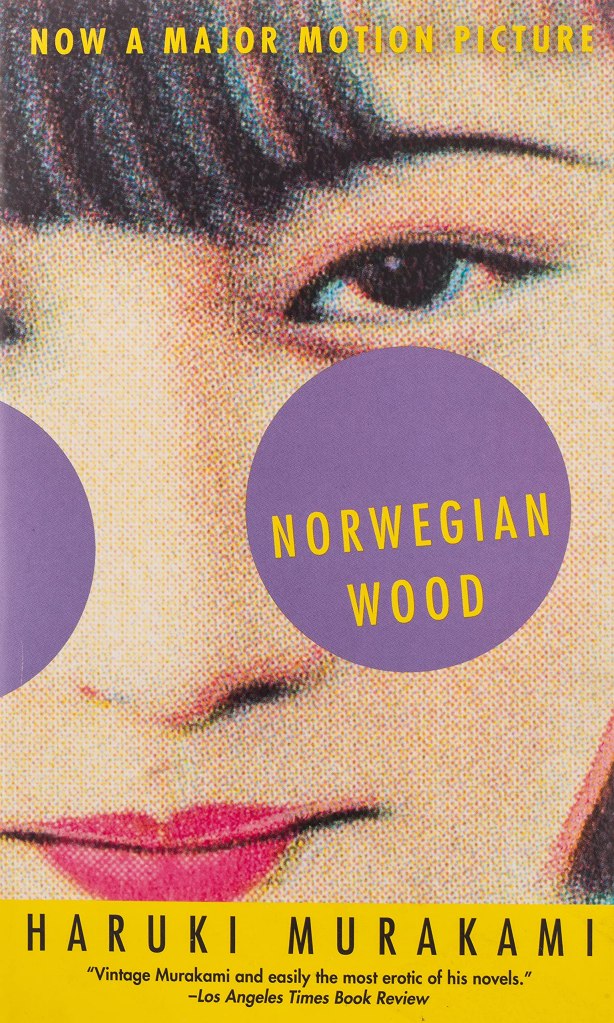
Published: 1987 (Kodansha)
Setting: Tokyo, Kyoto
Summary: The domestic reception to Haruki Murakami’s Norwegian Wood propelled the author to literary super stardom seemingly overnight. This novel, nostalgic and deeply feeling, is as much a period piece as it is a coming-of-age story set in Japan’s post-war coming-of-age. Toru Watanabe floats in and out of the lives of his childhood friend Naoko, her friend and mentor Reiko, and his eventual eternal love interest, Midori.
Toru Watanabe lives, breathes, sleeps, and loves at the turn of the 1960’s, a time of riots and music. Toru lives in a dorm with a ritualistic clean freak Stormtrooper, and a womanizing soon-to-be professional Nagasawa. Toru learns to not pity himself from Nagasawa, and to clean up after himself from Stormtrooper. A minor subplot of this novel is Toru’s dive in Nagasawa’s character. He finds out that Nagasawa is a decent friend, an iffy person, and a horrible boyfriend.
The real juice of this book lies in the three women who occupy Toru’s mind and heart. Toru’s relationship with a high school classmate, Kizuki, and his innocent girlfriend, Naoko, propels Toru into a dramatic and conflicting journey through love and loss. Kizuki commits suicide at age 17, leaving Naoko and Toru to pick up the emotional pieces, an act which has an unintended consequence. Naoko and Toru fall in love when they consummate their mutual interest, but it is fated to fail as Naoko voluntarily joins a commune-like rehab facility, and Toru catches the eye of the precocious Midori.
Midori, a fast-talking, and sexually adventurous woman, takes an interest in Toru from the moment they have a meet cute in a diner. She slowly learns to love Toru, dumps her boyfriend by the end of the novel, and asks Toru to take her and only her. She connects with Toru by going on dates, having him visit her dying father in the hospital, and testing him by dodging his calls until he truly finds the will to put her above all others. Toru is bound to lose Midori because of his preoccupation with Naoko.
Toru visits Naoko in Kyoto, meeting her friend and quasi-handler, Reiko. Reiko is an older woman, a patient and helper at the facility whose past haunts her. She was sexually assaulted by a thirteen-year-old piano student and had to leave her husband and daughter to seek care. Reiko carries her scars as wrinkles, but these faults make her the perfect person to help Naoko through her pain. Toru and Naoko share some moments which he doesn’t even know are real or not, songs at moonlight and walks in the forest. This dreamlike commune is contrasted heavily with the protests, the visceral nature of Midori, and the reality of his need for housing and money in Tokyo.
In the end, Toru sojourns across southern Japan to gain perspective, Naoko commits suicide, Reiko leaves the commune and sleeps with Toru before going to Hokkaido, and Midori accepts Toru for who he is. Toru moves into the 1970’s with a purpose after some beautiful wandering, he will be with Midori, write to Reiko, and never forget Naoko or Kizuki.
This novel, although not as cerebral or exploratory as Hard-Boiled Wonderland, has an irreplicable quality to it. The music I like, the kind of love stories I enjoy, and the coming-of-age genre I crave are wrapped in an economical and beautiful 297-page package.
Quote of the book: “Long after the firefly had disappeared, the trail of its light remained inside me, its pale, faint glow hovering on and on in the thick darkness behind my eyelids like a lost soul” (46).
I think this quote functions as an analogy of the presence of Naoko within his heart, she left a lasting imprint on him he will never be rid of, nor does he want to be rid of it.
Favorite character: Reiko, she, more than any other character, exemplifies the idealized 1960’s in my mind. I can’t help but want to talk to her more than any other character.
Favorite setting: Toru and the Stormtrooper’s dorm, I smelled and imagined this dorm room as if it were my own in college.
Favorite pop culture reference: Michelle, although this book takes a title from a different Beatles song on the Rubber Soul album, Michelle is my favorite song on my favorite record.
Please Stay for: The pacing and spacing, Murakami writes an enchanting and straight-forward love story while maintaining a pace and tone that lent itself a unique feel.
Please Question: The gratuitous appearance of the words “Norwegian Wood.” It seemed very on the nose, and I wish it were alluded to more than explicitly mentioned. I felt hit over the head at the mention of the word, as it was meant to cue an emotion I wasn’t feeling and didn’t want to when reading those sections.
 Will Reviews Things