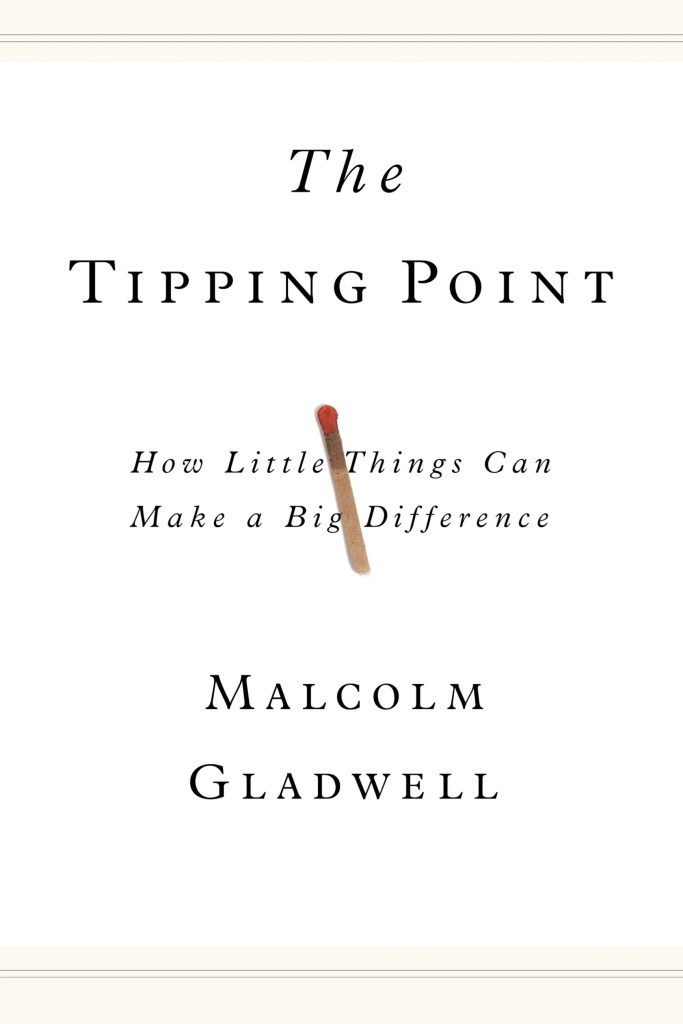
Published: 2000 (Little, Brown)
Setting: Malcolm Gladwell’s Brain
Summary: Malcolm Gladwell’s debut book is a thought experiment about how we can change our world, and a treatise on how we need to change how we think about solutions to these problems. Malcolm Gladwell shows us why Blue’s Clues was the evolutionary Sesame Street, and why 150 is the perfect cap a large group. Gladwell uses sociological and psychological studies, urban crime data, etc. to show us how sticky messages, environment, genetics, and the power of the individual all play a part in pushing crime rates, suicide rates, television viewers, revolutions, and sneaker sales to the next level.
What I found most interesting was Gladwell’s use of “Mavens” as a term to valorize, instead of question, intense curiosity. Maven’s catalog our world, Connectors integrate it, and Salesman move it. Gladwell manages to draw his inquiries without asserting that they are the whole-hearted truth, he leaves room to criticize or build on this study while also proving that we can see “tipping points” as legitimate phenomenon.
Quote of the book: “The world—much as we want it to—does not accord with our intuition” (145). This quote is the premise at the heart of Gladwell’s hypothesis, there is observable data and ways of thinking which are often more accurate than our intuition.
Favorite character: Paul Revere, much has been written about him, what he did in the revolution and what his role was. I had never thought of him as the perfect messenger-type until I read this book.
Favorite Setting: The Gortex Factory, this seems like the ideal workplace.
Please Stay for: Gladwell’s depth of research and exploration.
Please Question: The timing of the book, we have 20 years of data that may refute or change what we can learn from this book. It isn’t timeless, but the book’s central idea is.
 Will Reviews Things