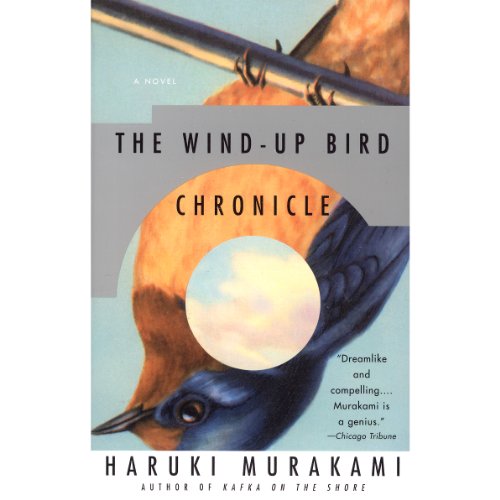
Published: 1994 (Shinchosha)
Setting: Manchuria, Tokyo
Summary: Toru Okada has a serene marriage with his wife, Kumiko, and their cat Noburu Wataya. Toru is unemployed and unaware that he out of touch with his wife. He meets a teenage girl, May Kasahara, who is obsessed with death but has an interest in Toru that takes center stage over his relationship with Kumiko. Toru meets with his sinister brother-in-law Noboru Wataya, a woman named Creta Kano, and her medium sister Malta Kano when the Okada’s cat disappears. Right after Toru and Kumiko’s cat disappears, Kumiko goes missing as well. Toru is forced to work with the Kano’s, Noboru and his henchman Ushikawa, as well as a healer and her son named Nutmeg and Cinnamon to find Kumiko.
Tangential to this plot is a story of the hidden history of Japan and the USSR in Manchukuo and Manchuria. Kumiko’s family and Nutmeg are connected to atrocities, espionage, and the supernatural through Nutmeg’s father (a veterinarian who kills all the animals in a zoo before the USSR takes it over), Kumiko’s family friend Mr. Honda and his friend Lieutenant Mamiya (who witnessed the flaying of his partner by the hands of Boris the Man skinner, a Russian soldier who can’t be killed by Mamiya in a concentration camp years after the flaying incident), and the presence of a wind-up bird which is also at the Okada’s house.
The third major plot element of this novel is Toru’s rivalry with his brother Noboru. Noboru is a prominent politician who used a supernatural power to defile Creta Kano and his and Kumiko’s sister (who committed suicide before the novel). He takes “something” out of them which in turn defiles them, and whoever he touches in that way is irrevocably changed for the worse. It is revealed at the end of the novel that Kumiko was “touched” by Noboru which led her to commit adultery, leave Toru, and eventually seek Noboru out to kill him.
What connects these bulky and confusing storylines together is a a pair of wells, one in Manchuria and one in a vacant lot next to the Okada’s house. Lieutenant Mamiya and Toru both spent time in the bottom of wells which gave them a sort of enlightenment and perspective (described as a flash of light). Toru uses the well as a door to a metaphysical realm where bit by bit he is able to construct a world where in Room 208 he is able to kill Noboru Wataya. When he kills Noboru in that realm Noboru loses all will to live in the “real world.” Kumiko goes out to kill him by pulling the plug on his life support, and Toru ends the novel waiting in his home for Kumiko after she leaves prison for killing Noboru.
One theme in this book is isolation. Toru is constantly by himself in his house, in the well, and walking around Tokyo. When Toru meets other characters, his loneliness is more pronounced. When the cat comes back and Toru renames him Mackerel, he still doesn’t have Kumiko. Another theme is power and desire, and what inside us feeds or removes that desire from us. Creta and Kumiko lose everything within them when Noboru absorbs it to feed his own power hungry.
This novel as too many moving parts to put any more words to, I can’t do this book justice. What gives this book a certain power is the sweeping nature of its narrative. What makes this novel frustrating (and not in the good David Foster Wallace way) is that it drops characters like the Kano’s while leaving many strings of plot untied and unorganized. This is one of those novels that I implore people to read but can’t explain well. That is the beauty and madness of this novel. The novel makes sense if you read it, and it is riveting and steeped in history. Yet, it doesn’t seem to treat its best characters storylines with the same attention to detail and finality (even if the finality is an uncertain future) as his other novels. Everything is up in the air and unclear, but such is life. I think that is why this novel received so much acclaim.
Quote of the book: “There was nothing wrong with your shooting. It was just that you couldn’t kill me. You aren’t qualified to kill me” (563).
Boris the Man skinner is a top-5 Murakami character, even if his bullet-bending powers are unconvincing.
Favorite character: May, her Adidas shirt and sardonic musings about death perfect the archetype of the cheeky and dark teenage girl that gives a Murakami protagonist-type perspective.
Favorite setting: The well, when Murakami gives himself a few pages to wax poetic about wells (and cats) it is a master class.
Favorite pop culture reference: The Thieving Magpie, this song is great.
Please Stay for: The deft mix of historical fiction and the exploration of the psyche.
Please Question: This novel is bloated and disconnected. I understand the disconnected part, it adds to the confusion of Toru’s character. But the novel is bloated, especially in the middle where seemingly nothing of consequence happens. The best character in the novel, Ushikawa, doesn’t appear until the final third of the novel.
 Will Reviews Things