Published: 2002 (Shinchosha)
Setting: Tokyo, Takamatsu, Kochi
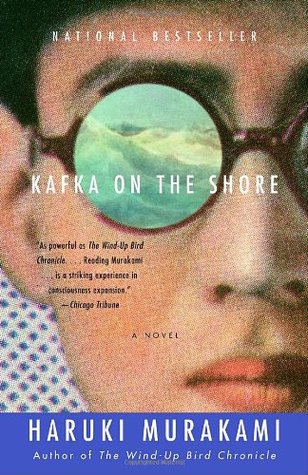
Summary: Kafka Tamura is a 15-year-old boy with an Oedipal curse hanging over his head. He is supposed to kill his father, and sleep with his long-lost sister and mother. He runs away from home to escape this fate, from Tokyo to Takamatsu, and along the way he meets his “sister” Sakura. He learns that there is a search party for him, and that he is wanted for questioning in the murder of his father. He settles in a quirky library where he meets a new friend, Oshima. Oshima is a gay transgender man who shows Kafka attention. Oshima helps him find peace and solace with trips to his cabin and Kochi, and introduces him to Miss Saeki, the manager of the library. Kafka’s inner voice, the boy named Crow, talks to Kafka in intervals, guiding him along his journey of self-discovery. This self-discovery proves to be a labyrinth, which at its heart is the key to finding out who Kafka is and who is mother, and sister are. Kafka ends up fulfilling the terms of the curse, he sleeps with Miss Saeki, who turns out to be his mother. After sleeping with Miss Saeki, he retreats to the cabin one final time to delve into his subconscious to say goodbye to his mother and acknowledge this fact so he can move on in the real world. He goes back to Tokyo at the end of the novel to talk to the police about his father’s murder, even though he didn’t murder him. Kafka seeks to move on and live in the brand-new world.
The alternating story in this novel focuses on a mentally challenged old man named Nakata, who was mysteriously wiped of his ability to read in a strange accident during the Second World War. Nakata gained the ability to talked to cats, and now lives off of a government subsidy. He is hired by neighbors to find lost cats but gets entrapped by a mysterious man named Johnnie Walker. Johnnie Walker kills and eats his cat friends right in front of him, goading him to kill Johnnie so he can move to a parallel world to complete a nondescript mission. Nakata kills Johnnie Walker and flees to Takamatsu with the help of a young man donning a Chunichi Dragons cap named Hoshino. Mr. Nakata is pulled to Takamatsu by a mysterious force, the entrance stone, which has a connection to Miss Saeki’s life. Hoshino assists Nakata by finding the stone, meeting a spirit-like figure taking the form of Colonel Sanders on the way. Once the pair acquire the stone, Nakata brings it to the library to help Miss Saeki die and leave her nostalgic existence. Soon after this, Nakata dies and Hoshino moves on with his life changed by his relationship to Nakata.
The two plotlines do not fully come together, but the fates of Nakata, Miss Saeki, and Kafka are linked by lightning, Oshima, the subconscious world, and a painting. This novel is one of my favorite coming-of-age stories, primarily because it gives ample attention to the riddle and confusion that is growing up. The labyrinth that Kafka must navigate in the novel is equal parts self-created and fated. The worlds we create in our mind collide with the ones at our feet in ways that take forms we don’t even recognize. But if we are the toughest xx-year-olds we can be then we will find the answers. Also, cats. Lots and lots of cats.
Quote of the book: “There’s another world that parallels our own, and to a certain degree you’re able to step into that other world and come back safely. As long as you’re careful. But go past a certain point and you’ll lose the path out. It’s a labyrinth.” (352).
This quote is a plot summary of Kafka’s journey in a few words.
Favorite character: Oshima, his calm nature and steady hand is one that anyone would be blessed to have available.
Favorite setting: The cabin, this is somewhere I would love to stay and figure out my inner demons. I need to get away from a television as soon as possible.
Favorite pop culture reference: Beethoven, I see Hoshino’s appreciation and fascination with Beethoven relating to Hoshino’s feelings for Nakata.
Please Stay for: The expansive trip through the human psyche and the pains of growing up and growing old.
Please Question: Sakura’s limited role in the book, she could have replaced Oshima in certain places, her role as the “sister” in Kafka’s imagination isn’t given enough room to explore.
 Will Reviews Things