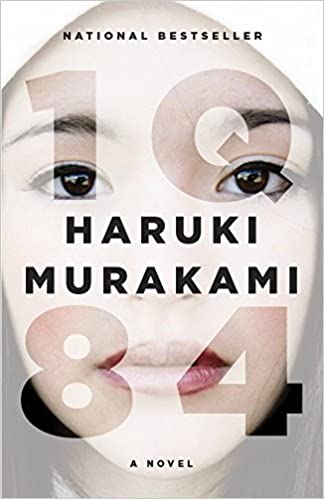
Published: 2009-10 (Shinchosha)
Setting: Tokyo, Yamanashi
Summary: Murakami’s epic starts and ends with a tunnel that connects reality and fantasy. This nexus is where Murakami has thrived in his career. 1Q84 explores the nature of reality, of religion in modern society, and the twists of fate which tie humans together. The three principal characters in this movie are a personal trainer named Aomame, a cram school teacher and ghostwriter named Tengo, and a PI named Ushikawa.
Aomame is a hired killer who enters the new world of 1Q84 by fate and kills domestic abusers with an icepick by choice. Her body has no fat on it, and she lives her life as sparingly. Aomame has had sexual relationships with women, a cadre of balding men, but her heart will forever be linked to the boy that held her hand at age 10, Tengo. She grew up in a religious cult, which helps her when her next hit targets the leader of the Sakigake cult. The Sakigake cult is a collective which brings together hard workers and intellectuals to the mountains of Yamanashi Prefecture, but the group has a violent past. Before Aomame goes to make the hit on Sakigake’s leader, we get introduced to a man named Tamaru who serves as the Dowager’s bodyguard. Tamaru supplies Aomame with Chekhov’s pistol, which she never uses, and helps her find Tengo later in the novel. When Aomame goes to meet The Leader under the cover of a physical therapy appointment, pistol in hand, she meets two goons named Buzzcut and Ponytail who tell her that whatever she sees she cannot repeat. Aomame enters the room and kills the leader with her icepick, but only after Leaders tells her the secrets of 1Q84, his role in Sakigake (which includes raping pre-teen shrine maidens under the guise of appeasing a supernatural force called The Little People), and that she is stuck in this world. Lightning strikes, the Leader is dead, and Aomame is impregnated through a form of immaculate conception. Aomame flees and holes up waiting for Tengo to appear with the suspicion that she is carrying a baby.
Tengo is commissioned by his boss, Komatsu, to ghostwrite a novel by Eriko Fukada (Fuka-Eri), a young 17-year-old writer who has an odd speech-pattern and an even more unusual backstory. Tengo finds out that the content of the novel, Air Chrysalis, mirrors real life in unexpected ways. Tengo figures this out when he observes the different aspects, he changes in the novel appearing in real life, including the presence of two moons in Aomame’s new world of 1Q84. Fuka-Eri describes a world where the Little People make Air Chrysalis to spread their influence in the world. Inside the cocoon’s are dohtas (daughters) who are copies of the shrine maidens The Leader impregnates, the maza (mother). Tengo gets to know Fuka-Eri, and through his revision of the novel and the reception to it, he gets drawn deeper into her former past, and the Sakigake cult her parents live in. Eventually, Tengo houses Fuka-Eri after her sudden disappearance months after the release of the novel. During this period, Fuka-Eri controls Tengo’s body, inserts him into her, and bridges Aomame’s womb to his penis to create a baby that will serve as a vessel to hear the Little People. Tengo can’t move his body as Fuka-Eri takes him to completion, lightning strikes, and Aomame becomes pregnant with her own dohta. Tengo spends the time before he learns the secret of this interaction with his ailing father in a beachside institution. Tengo calls this place “The Cat Town” after a short story he reads on the train there, and finds that this place is his own personal 1Q84, the place he has to wait in before he reunites with Aomame.
Ushikawa is introduced as a representative for an organization that will grant Tengo a stipend to continue writing his novel. Ushikawa is working for Sakigake to get information on Aomame, Tengo, Komatsu, and anyone Sakigake is suspicious of. According to Sakigake, Ushikawa is helping Sakigake preserve their secrecy and integrity. However, The Leader uses Ushikawa to assure him that Aomame will kill him, helping him end his suffering at the hands of The Little People. Sakigake doesn’t understand this, so when the leader dies suddenly, they send Ushikawa after Aomame. Ushikawa tracks Tengo and Aomame like a dog, but meets his fate when Tamaru goes to his hideout and kills him for Aomame.
At the end of the novel, Tengo and Aomame are finally united, looking at the two moons, with a baby in tow. The long for each other the entire novel with the memory of their handholding two decades in the past acting as the glue for these feelings. When Tengo and Aomame find each other, they exit through the same tunnel Aomame entered, into the “real world” of 1984.
This novel is Murakami’s epic, and any summary lengthier than this would do a disservice to the novel. Murakami blends the mysterious nature of cult’s ghostwriting, and magical realism to craft a novel that examines the nature of fate, reality, and storytelling. The novel may be about 200 pages too long, but that’s part of the difficulty of the novel. Nobody should get a gold-star for slogging through a novel of this size, but it is worth the read.
Quote of the book: “Tengo could hardly believe it—that in this frantic, labyrinth-like world, two people’s hearts—a boy’s and a girl’s—could be connected, unchanged, event though they hadn’t seen each other in twenty years” (1114).
1157 pages led to Tengo and Aomame being together, quotes like this make the waiting worth it.
Favorite character: Ushikawa, we see him in The Wind-up Bird Chronicle and 1Q84, his he so endearing because he is despicable, and he knows it. But he isn’t cute lie Gru in Despicable Me, he is the embodiment of evil, and we get his backstory in this novel. He is Murakami’s most complex male character, and one of my favorite literary characters.
Favorite setting: The Cat Town, I lived in a town that resembles the rhythms of the Cat Town. It was nostalgic to read descriptions of lazy beach towns.
Favorite pop culture reference: Chekhov’s Gun, the self-aware use of this literary worked for me. It’s not exactly pop-culture, but this novel was less focused on jamming in pop-culture references and more on Japan and human relationships.
Please Stay for: Ushikawa, The Leader, Tamaru, and Aomame.
Please Question: The length of this novel lends itself to some fair criticism. The story is straightforward, but it drags and has some corny sex scenes that read like a dime-store sci-fi romance novel.
 Will Reviews Things