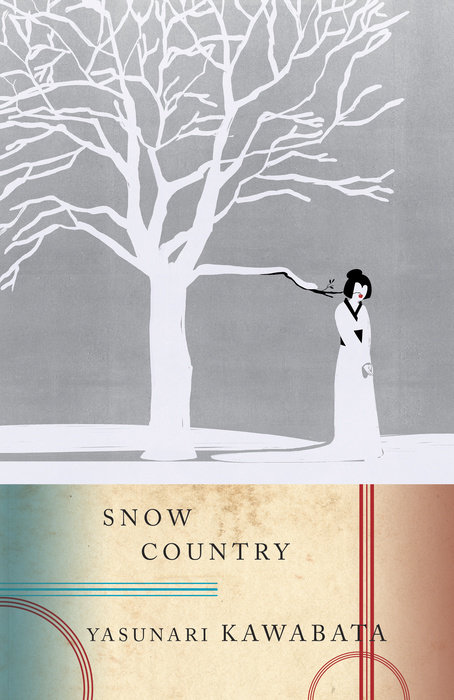
Published: 1948 (Serialized in 1930’s and 1940’s by Bungeishunjuu and Kaizo among others, translated into English by Edward Seidensticker in 1956)
Yasunari Kawabata’s novel, Snow Country, is a beautiful and sobering novel that transports the reader to a place near and dear to my heart, Niigata Prefecture. In Part One of the novel, Shimamura, a married heir to a decent fortune who spends his days as an unemployed ballet critique living in Tokyo, takes a visit to a Snow Country hot springs town in December to visit a geisha, Komako, he met previously in the spring. As he arrives on the train he sees the reflection of an alluring woman, Yoko, accompanying a man. Shimamura is taken by Yoko’s piercing gaze and the reflections she makes in the window as he sees her superimposed with the natural landscape. However, because she is accompanied, he turns his attention away from her as he looks to Komako, his spring-time tryst.
Komako is introduced as waiting for Shimamura for a considerable amount of time. The novel then intersperses scenic mountain landscapes and mountain living with the reunion of the two lovers, embracing and challenging each other to continue their temporary but passionate affair. Komako entertains guests most of the day, but sneaks off to Shimamura’s room at night, usually drunk, and starts to open up about how she both is falling in love with him but is pained by their situation. Komako is well-versed in dance, shamisen, and the myriad of other facets required of a geisha. She is young, around eighteen at the beginning of the novel, but she is both spirited and discerning. Shimamura vacillates between cowardice and passion, aware of the groundswell of feeling developing inside him that he needs to keep in check. Late night chats nestled up under the kotatsu provide the groundwork for their budding relationship. Walks in the daylight through the snowy climbs of the hot spring town reveal crucial details that make their love ill-fated. First of all, Komako is a geisha with strict duties and cannot be seen too often favoring one long-term lodger. Second, Komako also has a relationship with a man on the western coast of Niigata. Lastly, she works as a geisha to help a man living with her named Yukio. This is the same man who Yoko was on the train with and is coincidentally nursing him as she also lives in the house Komako stays in with the man. Shimamura is also married, and has a certain fascination with Yoko. Needless to say, there are many obstacles in front of this meteor of a relationship. Nonetheless, Shimamura and Komako have such passionate feelings that when Komako sees him off, Yoko runs to the station to alert Komako that Yukio is dying, Komako shrugs her off because she is so desperate to see Shimamura off. I want to pause here and come back to what I mentioned about the mountain scenery. Much of the novel is written in a style emblematic of a haiku, with the snow-packed scenery of Part 1 helping us understand Komako’s purity, and the darkness that envelops the season dooming our protagonist’s love affair. The mountain homes are old and shabby, a bygone of Japan’s imperial past, and Komako’s position as a mountain geisha is generally looked down upon compared to the geisha of Tokyo and Kyoto. So many details within the setting give the reader clues as to how they should view Shimamura and Komako.
In Part 2, Shimamura leaves, as he needs to return to his family, promising to come back in February. However, he arrives back at the hot spring in late fall, making this particular reunion with Komako bittersweet. She still comes to see him at night, but not without an excuse or a threat to blow him off. Komako also starts to feel more threatened by Yoko after she catches a vibe that they share some sort of connection. Yoko calls on Komako more in this section, and crosses paths with Shimamura. In one scene, Yoko and Shimamura have a lengthy conversation where Shimamura insinuates that his and Komako’s relationship is going south and that he has interest in helping Yoko make it in Tokyo after the death of Yukio, whose grave she visits frequently. But the season is late fall, where the rice is harvested and strung up on lines, the green onions preparing to be covered in snow, but most importantly the leaves are falling. This is the season of goodbyes, of flaring love that fades into the cold mountain night. Such is the love between Komako and Shimamura, who have one last night together which is emotionally halted by Shimamura calling her a “good woman”, signaling that she has grown up and maybe grown out of this affair at 20 years-old. Shimamura tries to give her the Irish goodbye out of the pain he felt for fumbling the end of this tryst, but as he leaves he runs into Komako outside the station, where she admonishes him for leaving without letting her see him off, even though she said she hated him for having her see him off last time. Suddenly, a fire alarm goes off and it interests both of them enough to chase after it. They find out that the house is Komako’s old house, where Yoko is found to be caught in as the flames slash their tongue to every wall of the house. Yoko, with a rather graphic description, falls from the second floor of the house. Komako retrieves her body with the soul seeming to escape it as they both sit under the stars with the weight of Yoko’s apparent death filling Shimamura with the roaring wave of the Milky Way hitting him like a ton of bricks, once and for all breaking the fantasy of his hot springs getaways.
Some final thoughts:
- I first read this novel in my junior IB English class at Gresham thanks to Ms. Hakala, and it is one of the only novels I have read more than twice. Snow Country introduced me to a part of the world, west-central Japan, I would not have otherwise learned about. Luckily, I was sent to this exact part of the country, Itoigawa, Niigata for my first stint in Japan as an ALT (Assistant Language Teacher). I read this novel again in preparation for leaving to go to Niigata, but of course I got to Tokyo for my orientation in August. The novel’s fall and winter locales were not exactly reflected by the cicadas and 95-degree summers I walked into initially, but once winter came I made it a point to visit Yuzawa, Niigata, the place where Kawabata did his studying for this novel. I remember walking through the snow to take a train to work and thinking that I was living, if only just a little, inside the novel I read about from early-Showa Era Japan.
- Mono no aware is the Japanese term most associated with the meaning of this novel. Its direct translation is “the pathos of things”, but in the context of the novel it more accurately reflects “the beauty and sadness in impermanence”. One of my favorite bands, Horsebeach, also has an appreciation for the term and the author who gave it new meaning. They named their third album “Beauty and Sadness” after Kawabata’s 1964 novel. I did not know this when I first got into the band, and only found this coincidence out later. Listen to Horsebeach, they are an indie-pop band from Manchester… home of The Smiths who are as mono no aware of a band as they come.
- Also…. there is another weird connection I have to Kawabata. One of my three advisors in my Master of History program, Alisa Freedman, translated Kawabata’s second novel, The Scarlet Gang of Asakusa, into English. Very cool!
Rating: 4.6/5
 Will Reviews Things