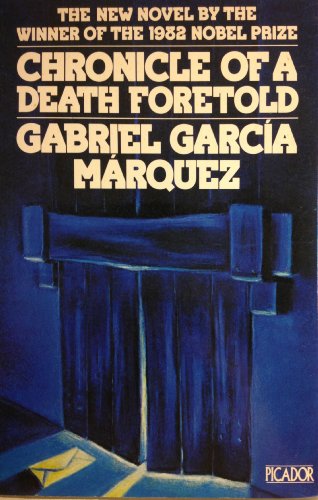
Published: 1981 (La Oveja Negra)
Gabriel Garcia Marquez’s novella, Chronicle of a Death Foretold, draws the reader into the recollections and imagination of a town still reeling from a brutal murder. Marquez’s unnamed narrator goes back to the town, 23 years after the murder of Santiago Nasar, to put the pieces together of that fateful day. The reader receives a beautifully haunting quilt of recollections from former lovers, rivals, interlopers, and from the woman who passively ordered the murder of Santiago, Angela Vicario. Angela, engaged to be married to a mysterious man named Bayardo San Ramon who, arriving six months before to wed a virgin woman, is told on their wedding night by Angela that she lost her virginity to Santiago. Bayardo runs out on her, prompting Angela’s mother to beat her and her brothers, Pedro and Pablo Vicario, to go looking for Santiago to officially return her honor. Pedro and Pablo track down Santiago in the early hours of the next morning and butcher him with knives, spilling his entrails out of his body. Pedro and Pablo stand trial for three years, while Angela stays jilted for almost twenty years, until a fattened and weathered Bayardo comes back to accept his bride.
The linear plot is fairly straightforward, but the trick of the novel is that each successive page unravels and re-ravels the narrative of what happened from the wedding day to the killing. From examiner reports, magisterial reports, eye witnesses, and hearsay the narrator takes us through who Santiago, Angela, Bayardo, and the brothers are as well as how all the other characters in their orbit felt about them. Santiago, of Colombian and Arab descent, is the heir of a small estate and is, according to who you ask, either a highly moral and disciplined man or a womanizer who is known to frequent a brothel and most likely took Angela’s virginity. Angela is the poster-child for purity, and her brothers are both men who have served their country but are not known to be violent whatsoever. So when Angela, who is really out kicking her coverage with the debonair and white knight Bayardo, is seemingly violated Pedro and Pablo have the duty to avenge her honor. With these dynamics sprinkled in throughout, the real meat of the story are the townspeople. Each person that these five central characters interacted with between the wedding and the moments right up to the murder heard that Pedro and Pablo definitively said they were going to kill Santiago. The butcher shop owner, the milk shop owner, friends and relatives of Santiago including his psychic mother, and police officers all fail to inform Santiago, sniff out the truth of the brother’s threats, or fail to care about his fate. Santiago’s death was foretold by the collective apathy of the town towards his fate. There was no actual evidence of Santiago having relations with Angela and so the entire town, not just Pedro and Pablo and Angela, were his judge, jury, and executioner. This failure to stop an impending murder leaves an enduring metaphysical stench on the town and asks the reader to examine whether we can truly control our fate, or whether it is decided by those around us.
Some final thoughts:
- In this novel, there are a few key instances of magical realism, a staple of Marquez’s writing. However, unlike Haruki Murakami’s use which usually has a central role in plot, character, setting, and motif, Marquez uses it as emotional symbolism. I did some research into how Marquez and his contemporaries viewed his use of magical realism, and I found that Marquez believes that this moniker sways more into the exoticism of the “magical” while sidelining the “realism”. Unlike Murakami’s talking cats and wells which transport one to another place, Marquez uses distorted or exaggerated (“magical”) images to evoke the real emotions inherent in human life. For example, the literal stench of Santiago lingering in the town or his entrails being cut out of his stomach for all to see while he is still alive.
- This is another book, like Kawabata’s Snow Country, that I read during my junior year in high school. However, I hadn’t revisited this one since and am just now realizing that this novel, like Snow Country, has a setting of a brothel. Why was Ms. Hakala using so many books with brothels in them?
Rating: 4/5
 Will Reviews Things